Jay AI Fleet Masterclass | How to Save Time & Money with AI
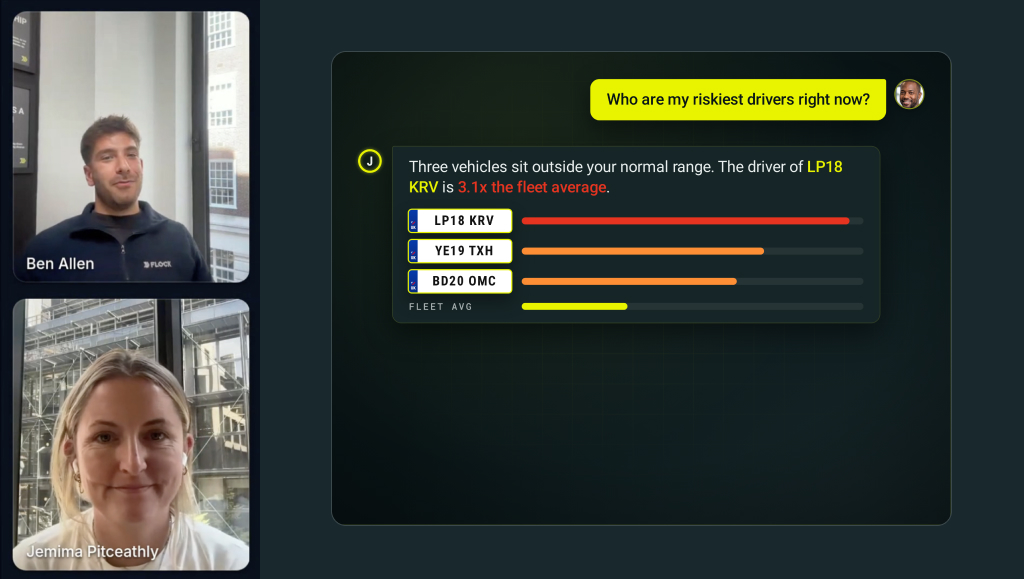
Jay is the virtual fleet expert, live now for all Flock customers and brokers.
Ask a question - "Which vehicles need my attention today?" - and Jay analyses your fleet's telemetry, policy, and claims data, then comes back with a clear, actionable answer.
In this masterclass, Ben Allen and Jemima Pitceathly, the team behind Jay, deep dive into what Jay can do, the questions fleet managers are already asking, and how to use Jay to improve fleet performance, reduce risk and save money.
[0:00] Ben Allen
Today is all about solving a problem that we hear every day from our customers. That there's just so much data, but I just don't have much time to turn it into any action. So today, what we're going to do is we're going to show you how we're tackling this problem at Flock and meeting our new colleague Jay, who's going to help us deep dive into this particular problem. So without further ado, here's our running order.
We're gonna start with some intros, showcase our new mutual colleague. We'll give a live demo of the Flock platform. We'll show Jay in action and then we'll do a Q&A with you at the end. So I'd encourage you as we move through the webinar today to get your thinking caps on and ask any questions in the chat as we go along, and both hosts will answer them when we get to the end.
So we'll start with the introductions, and without further ado, I'll introduce you to Jay. And I'd like you to think of Jay as the newest member of your safety team. Jay will live within the Flock portal and enables you to query any data that you see within the portal when it comes to safety through basic natural language. So we're going to showcase you the latest, most exciting developments of Flock's journey today.
Without going on too much longer, my name is Ben, Senior Customer Success Manager here at Flock. I've been here for five years. Many of you may work with me already, or my wonderful colleague Daisie, as part of the safety team, where we deliver in person safety workshops to help customers and brokers manage their insurance policy throughout the life cycle to create long term relationships and more profitable businesses.
And now I'll hand over to my other co-host, Jemima. Hi, Jemima.
[1:57] Jemima Pitceathly
Hey Ben, hey everyone. Great to be here. Just a quick intro before I'm gonna cover a bit of the background context as to why we built Jay before we give you a demo. But I'm Jemima, I'm a product manager. I've been here for a while, like Ben, four and a half years, and have been heavily involved in building out the safety proposition that you see on the Flock portal. Over the last six months or so, I've then been working with our very talented tech team to build out Jay. And yeah, we're going to be focusing on Jay, what Jay can do for you, a bit of a demo today.
So just to set a bit of a background context, over the years at Flock, we worked super hard on building out our safety proposition, filled with very rich dashboards and data. Yeah, we've built lots of nice dashboards with data and over that time we've been speaking to our customers lots. And one of the key problems that they identify is that they're severely time poor, they're often in a rush in the mornings, people don't necessarily have time to log into the portal and dive into dashboards looking at where they need to get their data.
We service lots and lots of different customers who all have different types of operations and types of things that they need to do in their day-to-day. And we just decided that it was an impossible task almost to build a dashboard that is fit for purpose for everyone. And about a year ago, we ran an internal experiment where we connected our telematics data to a large language model called Claude.
And we basically enabled our own internal teams to start interacting with that data using natural language, and it basically unlocked huge amounts of value, and we started to think about how we might be able to apply and utilise that for our customers too.
So that is where Jay emerged. So we built Jay into the Flock portal as a virtual fleet safety expert. As we've mentioned, users can ask questions in plain English about their data and they'll get answers back in seconds rather than having to spend the time going through dashboards trying to dissect the information that they should care about. And Jay is available 24-7.
So what does Jay have access to? At the moment, Jay has access to policy data, telematics and safety data, and then claims history. And basically Jay, one of the things that Jay is like the most powerful at doing is tying the dots between all three of those data points and bringing together insights that ties those three things together.
Having some issues with the slides. So in terms of how we built Jay, the tech team at Flock have been working super hard on building Jay. Jay is an agent which is basically in simple terms made up of lots of different tools and lots of different capabilities all tied together. And when a question comes in in natural language, Jay will basically decide which tool to use to get the answer, which action to take, which kind of workflow to go down.
So yeah, collection of lots of lots of different tools looking at lots of different data points. We basically built out Jay really closely to customers. So we worked super closely with customers on the things that they would like to see, the questions that they would like to ask, and basically the capabilities that they would like to see from Jay.
Under the hood it's all quite complex, but we basically wanted it to feel as intuitive as possible for our customers.
So Jay is now live in the portal, but we're gonna do a demo in a second. We wanted to just talk through a couple of the use cases that we've seen from our customers interacting with Jay. So Ben spends hours and hours and hours on calls with customers. So Ben, can you just talk through this first use case and what you've seen like customers really unlocking with these kind of questions?
[7:09] Ben Allen
Yeah, of course I can. I think this is probably the most exciting time for all of us. Like you said, customers no longer have to listen to me drivel on for 30 minutes every time we meet, but can access this 24 hours a day. And this is what we're trying to do is empower humans through data. And now, Jay, where what we can help to do is help the fleets to become safer, smarter, and easier to insure over time. So Jay will help you to not just reduce risk and not just pay claims but actually turn your decisions into action. And by using Jay, what we're seeing is it's becoming a lot more clear of what preventative things that you can take to then act on with your fleet and then hopefully save a lot of time. It doesn't feel like data's really been the problem. The bottleneck we've always seen is the amount of time it takes to trawl through it.
So rather than just sending reports and giving dashboards, it's about giving answers as fast as possible so that best intervention can happen, which is, as we know, the one that happens before the claim. So one of the key questions we'll always ask is who is my riskiest driver? Now we want to ensure that we collect this data to then act on it. So Jay will then very quickly give you, let's say, in the last seven days, which particular registrations have been the most risky. And then as we've seen in the use case there, what percentage of those are they speeding? So you very quickly start to get an understanding. Rather than going through the data and searching for it yourself within one question, 30 seconds, it will give you that answer to make a much safer business, but to make it a much more efficient process to extrapolate that data.
Cool. Now, what we also like to see is changes over time and trends. Instead of learning a particular system, Jay learns how you work. So by asking it questions that you might ask a colleague or a fleet manager or something like that, then you can get all of the information from Jay by asking it in natural language. So I would let Jay know that I may have coached a particular driver and I want to see whether that particular driver has improved.
Which goes from sort of reactive reporting to proactive decision making. I can then decide do I need to coach the driver? Do I need to call them in and potentially give them a warning? What sort of things can I do off the back of that by working with Jay and getting reports from the system, which we'll show you a little bit later. And all of this encompasses into getting more value from your insurance.
So rather than your insurance just being something you spend a lot of money on and a cost centre, we're trying to turn it into a proactive performance partner where you can interact with Jay, get the answers you need to hopefully make your business easier to insure over time and make sure your drivers are safe on the road.
Sometimes, especially with these new modern trends emerging, it can be difficult to know where to start. What do I ask Jay? What sort of things can I go to Jay for? AI is used in many different ways at the moment in terms of how people interact with it through business, but you can just ask it questions to try and understand where the patterns are. Risk generally doesn't just appear overnight. It would be something that's gradually creeping its way into your business.
So what we're trying to do is identify patterns instead of individual incidents. So let's say an emotional question, is there anything I should be worried about? Rather than always looking for cures, we're trying to look for cheaper preventative measures. So Jay will then show me where potentially patterns are emerging within the data that we see. So it essentially removes hours and hours of manual analysis and gets you to the why very quickly.
And by doing so, you're turning your safety from a manual compliance exercise, which is boring and can be quite laborious, to something that gives you a commercial advantage where in a few clicks and a few questions, you can then learn as much as you can about your drivers and their behaviour. And as we know, good safety is a key to a good business. So therefore as a result, you can then act on it and then eventually have fewer claims and save money on your premiums as well.
[11:38] Jemima Pitceathly
Before we go into a demo, just want to cover one thing as well. I think Jay is self-improving. So every single interaction that a customer has with Jay, Jay will log whether it can answer the question or not. And if Jay is unable to answer the question, we are logging that in the background and then in the future, we're building new tools and capabilities based on what Jay can and can't do.
So effectively, Jay is self-improving. We feed all of the insights and capture all of the insights of how customers are interacting with Jay and then directly feed it into our product roadmap and basically ship improvements as quickly as possible around what customers want to see.
Some examples of what we've built recently is we saw that customers were asking lots of questions about connectivity and asking which vehicles were unconnected. So we built a tool to help customers with identifying unconnected vehicles super quickly.
More recently as well, we saw that after asking and querying some initial questions, often a follow-on step for a customer would be to ask to download a PDF to send to a driver or to another depot. So built in a PDF tool super quickly, so customers can now do that.
So I think really important to highlight that, the possibilities are endless for where this goes. It is very much dependent and based on what customers want to see and how they want to interact with Jay in the future.
Now we're gonna hand over to you to do a bit of a demo. So hopefully this will go well because we all know how live demos normally go. So do you want to take us away?
[13:33] Ben Allen
Thanks, Jemima. I'd like to think, given the number of times I've done this, I should be able to hopefully get it working. Especially, rich coming from a tech company as well, so that's always good to see. So obviously, in terms of where we are now, there may be some of you who've never seen our Flock portal, which is our online digital product, and your one-stop shop to digital policy management. So I'm going to give you a high level overview of the portal so you can find where Jay lives and all the things that it can do for you.
In order to manage your insurance policy. So upon logging into the portal, you'll see your fleet overview, how many vehicles you have on cover or off cover at any one time, how many vehicles or the total percentage of vehicles that are sending data to Flock, which is the most important thing, really, when it comes to Jay and safety. The more vehicles you have connected, the richer the data source you have. When I scroll down, this is where you make MTAs and adjustments for your vehicle changes.
Which you can do and get summaries of the vehicles and what you've got on. So adding and removing vehicles is all done online and really, really simple in order to manage your fleet. As part of our policy, and what myself and Daisie work with customers towards, is essentially a rebate option whereby you're able to accumulate up to 10% of your policy premium as a rebate that we would pay to you should you decide to stay with Flock for a further year to incentivise better behaviour and policy management.
All you have to do is improve three things, your loss ratio, your safety score, which we take from your telematics data, and your reporting speed. If you do these three things and work collaboratively both within your business and with us, then we give you that incentive back at the end of the year, which you can spend and invest into whatever you like.
If we continue, we take all of your telematics data from your devices and then surface it onto the portal. So this is the safety section where you get an overview of your policy and how your vehicles are performing at any one time. We also have the vehicles page where we can have a look at individual vehicles that are within your fleet and dive into the trips and data that come within them, see how many claims particular vehicles have had, and gives you an overall synopsis of individual vehicles.
Once the trip is finished, then it's uploaded into the Flock portal. So you get every single trip that's recorded within the telematics device uploaded within the portal as well. So you'll be able to see all the driving behaviour at the click of a button. Something that everyone wants to see is claims. So you're able to report claims directly through the Flock portal. Take away the old ways of calling up or waiting on hold for half an hour. You simply report your claims through the portal, you get some information around insights of your claims, and then below here you've got your actual claims listing and an ability to click in and see more information about individual claims as well. We also have the document section where you've got all of the resources that you need from the binding of the policy, where you can get these at the touch of a button and as well the billing section where you can see all of the changes that you've done and any applicable invoices or changes that relate to that from a financial perspective.
So it's an amazing way to manage your policy. And essentially, we can now move on to showing you where Jay lives. And Jay lives within the Flock portal. So when you first go into Jay, it will give you some suggested questions to help you kick off if you're not sure what to ask Jay immediately. But once Jay's got to know you a little bit more, that's where it will give you more personalised questions and suggestions that you should probably ask Jay if you are interacting with it. Now I've already kicked us off a little bit, but I'm going to show you a little bit around how Jay works and what you can do when you start a conversation with Jay.
So immediately I just kicked us off with Tell Us About Yourself. It's introduced itself as Flock Safety Agent, helping you to understand your telematics and claims data, turns your fleet data into answers, and covers safety, speeding and risk, trip investigation, and connectivity. It can give you content, which I'll show you shortly, but it can't tell you what to do to discipline a driver.
And unfortunately it cannot comment on renewal pricing. We still need humans for that. So as an example, let's say I came in and I was like, tell me about my speeding in the last seven days.
Rather than me going through every single vehicle and every single trip from every single driver, Jay is going to do an overall safety summary. So you can see here it's already given an overall score, distance, potential speeding information, and where that speeding is happening. It's also decided to pull out five vehicles, which we should take a look at. And I know vehicle five was a new driver, so that's something I want to investigate. It will then give us charts, graphs, and tables.
But out of these five, definitely vehicle five is one that I want to have a look at. So I could be like, the driver of vehicle five is a new driver, so the data concerns me. Please can you make me a PDF to send to this driver to support my conversations with him? Please include the speeding data only.
So what Jay will then do is it's turning data into action here. It's giving me supportive materials that I can then go through with the driver in the one on one. So rather than sending screenshots and WhatsApp messages or anything like that, it's pulling a little bit more around the data into a PDF that I can send to him on WhatsApp as well. So you can see there, very quickly, it would have taken me an hour to go through all the trips, all the metrics, and make it into a report. And Jay's done it incredibly quickly so that I can put that into action as well.
So if I wanted to go even further, let's say, for example, I have two depot managers that I wanted to send the scores to. So I would say I have two depot managers. Please create me a PDF of all the driving scores per vehicle in the last 14 days. I will send it to them and they will speak to every driver with a score of less than 40.
So this is where we start to be able to give more higher-level oversight data to managers so that they can action it in the morning before the day starts or at the beginning of the week, however, a business would like to do that. And by getting you this information as quickly as possible, it will give you the chance to, with as much transparency as possible, pull in the people or intervene with those that you need to as well. So it's going to look at all of the data between a particular period. The more specific you are, the better results you get. So then therefore it will give me what I need at the end as well.
Now in terms of moving on, a lot of what we're trying to do is identify patterns and trends and Jay can do this as well. So let's say for example I wanted to, I've got all my PDFs and I wanted to compare particular data sets one month to the next, one week to the next, one day to the next, then I can also do that as well. So what you can see here is from raw data to giving you content, it works incredibly well to give you what you need. So if I said how does my safety data compare between June and July 2026? Am I getting better or worse?
And let's see what Jay comes up with in order to do that. So Jay's going to deep dive into all the data across the two months and then compare and contrast what it sees in order to essentially gather that raw data and give you some conclusions. So we're getting worse in July, only by one point, but we can see that things are moving in the right direction. So the risk is growing and it's going to give me some suggested actions as well on what to do. Because sometimes you don't know what to do when these things occur, so Jay will always help to push you in the right direction.
Now Jay's amazing at giving things to customers and brokers that it can do. But what's if I wanted it to do something a little bit different. So I want to add vehicle YP70 GBX from tomorrow. Can you do that? And let's see if Jay can add a vehicle for me.
Now, Jay can't add vehicles at the moment. It's a read-only assistant for telematics and safety data, so it can't change your policy schedule. But this is the sort of thing that we want customers to do. If you find things that you can't get Jay to do, then all you have to do is either refer it into Flock directly through your broker or in a meeting with your customer success manager. But if you do find something that you would like it to be, like a new feature, then if I click bad response and give it thumbs down, then the team will see it and we'll get some continuous improvement going with you.
So hopefully that brings us to the end and a really nice way to wrap us up. Jemima, have you got anything to add before we go to the Q&A?
[23:16] Jemima Pitceathly
Nothing other than these kind of responses where Jay can't answer is being directly fed into the tech team and the backlog and what we're working on. So that's like such an important part of taking Jay the step further.
[23:32] Ben Allen
Brilliant. Appreciate your input. I think it's really clear that we're trying to hopefully get as much value out of your insurance policy in the portal as possible and continue on to being your excellent performance partner to gain you a safer and more efficient business. So after this session, I really implore you to go on, have a play with Jay, see exactly what you can do and all of the trials and tribulations that you may face in your job. Run through it, and then we'll go now to the live Q&A as well. So thank you so much.
[24:02] Jemima Pitceathly
Cool. So going to the Q&A, first is a question that we get all the time. Ben, I don't know how many times you've been asked this in your sessions, but why is he slash she called Jay? I wish it was from a more creative reason, but it was we were brainstorming what we should call this in the office one Friday afternoon. And we decided that we'd wanted to go down the more personalised route with naming because
There's lots of AI products in the market and I think the word AI can seem quite intimidating. So we wanted to go with something that felt a bit more personal. And we were sat around in the office on Friday and someone said, what about Jay? Because we were thinking about names that related to birds because our name is Flock, so like a flock of birds, and then someone said Jay and then looking into the deeper meaning of Jay. A jay is a bird that proactively watches over a flock.
And we just thought that it related really nicely to safety and our kind of proposition and what we're trying to do as well. So that's where it came from, and it just really stuck as soon as we started saying it, it just worked. So yeah, that was the first question. Sorry, I'm just having a little read through. So some pre-submitted questions. I think this one's already been answered.
Can Jay pull a speeding report that we can share with drivers? As Ben's just shown, you can download a PDF and then that can be shared onwards with drivers. Can Jay compare driver performance this month versus last month? I think as Ben has already shown, trend analysis and looking into trends is one of the most powerful use cases for Jay. So yes, very much so. Ben, there's one here for you.
So is there some sort of tech our clients need to install to benefit from the telematics part of Jay?
[26:07] Ben Allen
Yes, so it's a great question, Sharag. Thank you. So in terms of the technology you need, then all you need is the telematics devices within the vehicles. Now, if you are new to Flock, it sort of comes in two ways. If you don't have telematics installed already, then we can provide this to you as part of your policy from a business called Matrix IQ. We send you out the hardware, you install them, and then all of a sudden you'll start to see the data come through from the vehicles into the platform.
If you already have telematics installed, then what we will do is we will do an integration with that telematics partner that you have and then aggregate that data into our system, taking all of the speeding data that we need to then show it to you. So we either give it to you or we integrate with your existing devices.
[26:57] Jemima Pitceathly
Great. Ben, while you've got the mic, there's another one for you. Are claims handled internally by Flock or outsourced?
[27:03] Ben Allen
Nice. So at Flock, we do have a claims team that will be on hand to support you whenever you like. But as part of your policy with Flock, you will be underwritten by Admiral. Those claims are outsourced. So we have two companies who do that for things like own damage claims and interventions. Then we have FMG, who we work with, Fleet Management Group, and then for all third party claims, those are outsourced to a company called Horwich Farrelly, who are based in Manchester.
So our internal team will support you throughout that journey and also the team at Admiral as well. And that's how our claims proposition works. You report them to us through the portal and then they'll go off into different streams for you to manage as well.
[27:49] Jemima Pitceathly
Cool. Does Jay allow instructions by voice? Not yet, but that's definitely something that we want to build in. Yeah, I think that would be a cool feature. So we'll think about that for the roadmap. If a client renews for the second year with Flock, can claims be compared over different years? At the moment Jay is restricted to one user and kind of one policy year, but it's definitely a capability that we're looking at building out in the future. I think also for brokers being able to have cross-policy views so that they can kind of manage across a portfolio of business and stuff like that. So yeah, definitely looking at doing that. But for now it's just like one policy year at a time. And are there any other questions?
[28:40] Ben Allen
I think there's one good one for you there, Jemima. So what's coming next for Jay?
[28:45] Jemima Pitceathly
Honestly, we've got a big old product roadmap coming up. I think follow-on actions is something that customers are really asking us for at the moment. So creating like custom reports based on the time frames and the periods and time that customers want to see their data for. So moving down the more action oriented route so that we can start to take action on behalf of our customers.
That also includes things like MTAs and adding and removing vehicles and that kind of thing. Like I said earlier, the possibilities for Jay are really endless. I think there's so many directions that we can take this, but I think for now, making Jay basically superpower your fleet and take action and just make your fleet management process just as easy as possible is where we want to focus our time and energy.
[29:44] Ben Allen
Thank you so much. Really appreciate it. And thank you so much for everyone for getting your questions in. It's been really insightful and very fun today to go through our and your new latest colleague. So within our sessions, when we see you face to face, I'm sure myself and Daisie will be discussing all of the things that come with Jay and the amazing improvements that we'll make through the use that you're going to give it. We really appreciate your time today. And I'm sure we can go out now and enjoy the weather. So thank you so much and have a lovely rest of your day.
[30:14] Jemima Pitceathly
Thank you everyone.
[30:15] Ben Allen
Thank you.

[email protected]